Human motion capture and human-machine interaction (HMI) technologies are rapidly advancing toward higher precision, more degrees of freedom, and more natural interaction. A team from the Shanghai Institute of Ceramics, Chinese Academy of Sciences (SIBCAS), in collaboration with Professor Ho Ghim Wei of the National University of Singapore, has developed the SPIM (Soft, Piezoionic, Multi-Dof) flexible piezoionic sensor, published in Nature Communications (Title: Ultrasensitive multi-degree-of-freedom piezoionic sensor via synergistic hydrogel-ion interactions).
Through dual innovations in materials and structure, it delivers the ultimate solution for “natural interaction”: turning the sensor into a “second skin” for the human body, where physical movements are directly converted into digital commands.
Disrupting the Status Quo: Overcoming Three Major Technical Bottlenecks at Once
Traditional flexible sensors suffer from continuous power consumption, susceptibility to interference, or response only to dynamic stimuli. Existing piezoionic sensors are limited by low sensitivity (typically below 0.5 mV/°), narrow detection range (mostly below 120° bending), and single-axis response, failing to monitor multi-degree-of-freedom joint motion.
The SPIM sensor solves these challenges via material-structure synergistic design, validated by multiscale theory and experiments.
01 Material Revolution: The Self-Powered Magic of the Ionic System
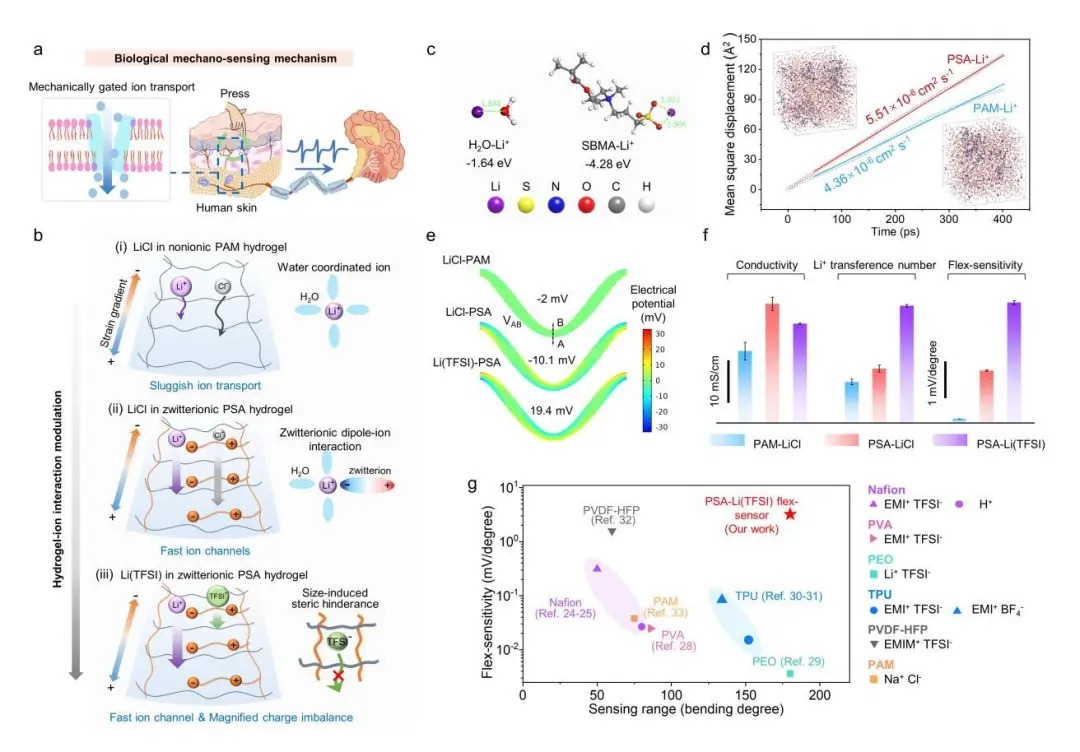
The core is an ionic system composed of zwitterionic hydrogel (PSA) and lithium salt, led by Special Researcher Cheng Yin and Researcher Wang Ranran from SIBCAS.
- Energy mechanism: Ion-dipole interactions promote ion channel formation; steric hindrance amplifies the mobility imbalance between anions and cations, achieving an ultrahigh sensitivity of 3.2 mV/°.
- Theoretical verification: Density functional theory (DFT) calculations confirm that the binding energy of Li⁺ to the SBMA group in PSA (−4.3 eV) is stronger than that to water molecules (−1.6 eV). Molecular dynamics simulations verify superior ion diffusivity.
- Biocompatibility: PSA hydrogel has a Young’s modulus of ~14 kPa, matching human skin. It fully recovers elastically after 50%–450% strain cyclic stretching, providing excellent wearability.
02 Structural Innovation: Quadrilateral Prism Design Solves Multi-DoF Challenges
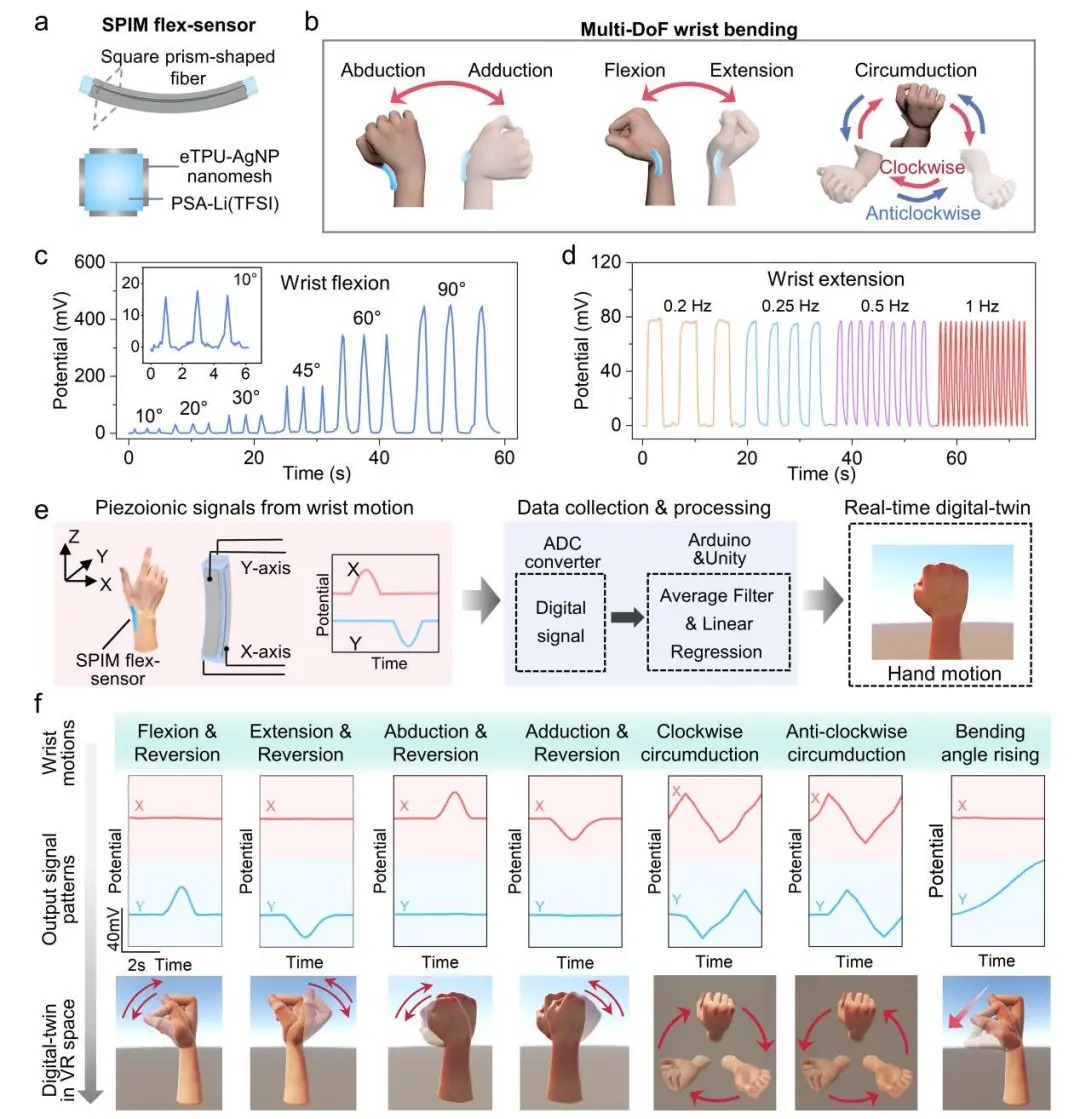
The SPIM sensor adopts a quadrilateral prism-shaped PSA-Li(TFSI) hydrogel fiber with symmetrically distributed nanomesh electrodes.Bending deformations in different directions are accurately decoupled in the electrical signal space, successfully capturing complex wrist motions:flexion/extension, abduction/adduction, and clockwise/counterclockwise circumduction.
Electrodes use an eTPU-AgNP nanomesh structure, forming strong interfacial coupling with hydrogel via hydrogen bonds, ion-polar interactions, and electrostatic attraction, with an adhesion strength up to 27 kPa, ensuring stable conductivity after 10,000 bending cycles.
- Response time: 200 ms
- Recovery time: 100 msPerfectly covering the natural motion frequency of human joints (0.05–4 Hz).A tiny bending angle of 6° produces stable, distinguishable signals.
03 Performance Breakthrough: Key Metrics Refresh Industry Records
SPIM sensor comprehensively outperforms traditional flexible sensors:
- Sensitivity: 3.2 mV/°, 2–6× higher than the industry average of 0.5–1.2 mV/°
- Detection range: 0–180° full linear range, more than double the traditional 30–90° nonlinear range
- Minimum recognition angle: 6°, 60% higher precision than the conventional 15–20° threshold
Cyclic stability: 10,000 cycles without attenuation, 2–3× longer lifespan than traditional 3,000–5,000 cycles
Scenario Application: From Lab Validation to Practical Exploration
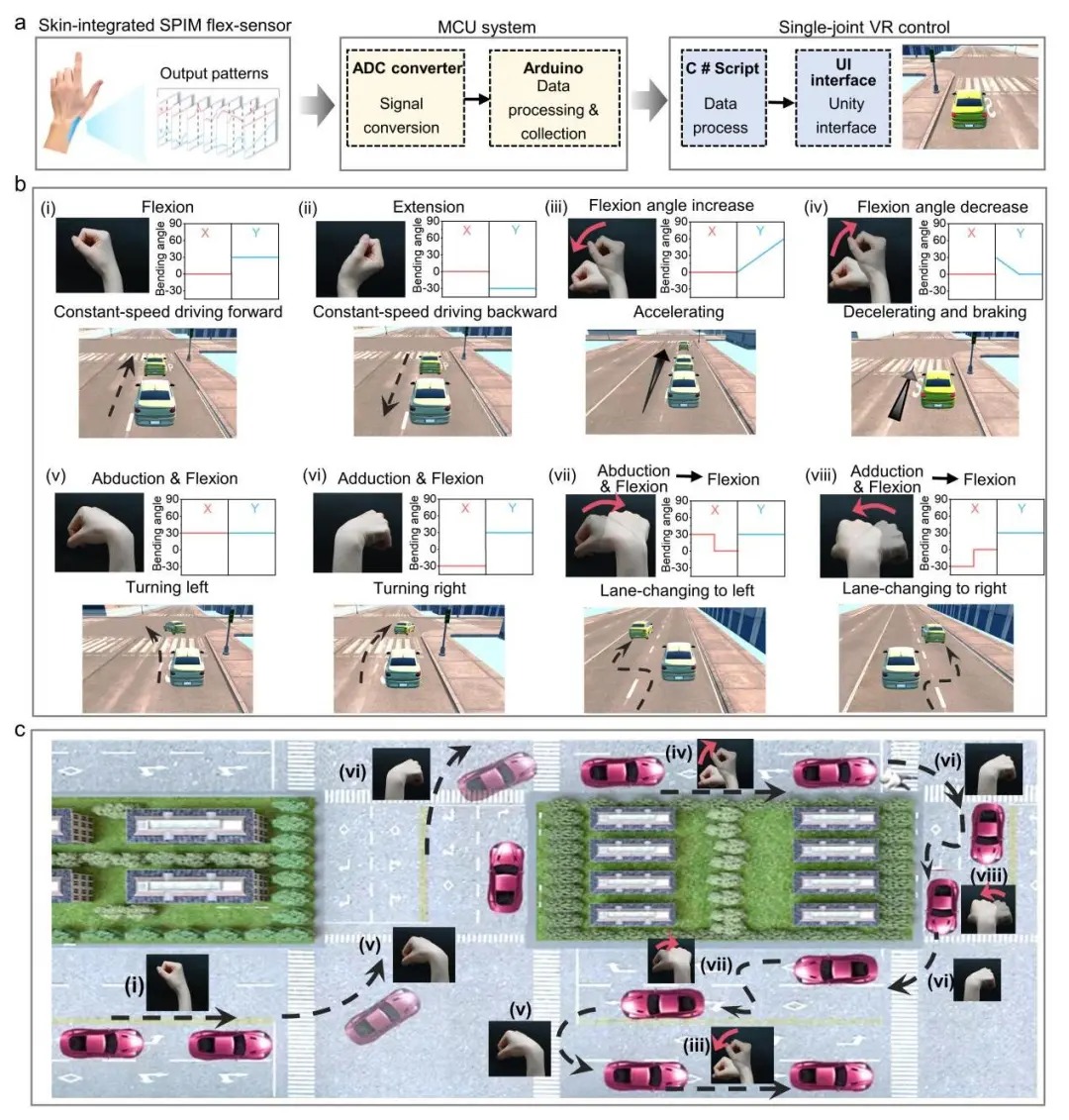
The sensor has realized complex wrist motion capture and digital twin reconstruction, converting wrist movements into VR control commands. It enables single-joint-driven steering, acceleration, lane changing, and other complex interactions, providing a lightweight HMI solution for the metaverse, with promising applications in real-time high-precision biomechanical analysis.
SPIM sensors can achieve complex control of VR scenarios through single-joint limb movements, proving their practicality and convenience as HMI interfaces.
When attached to the skin, the direction and amplitude of wrist bending are converted into X- and Y-axis potential signals, processed by an MCU system into VR operational commands, directly mapping real human motion to virtual world control.
- Figure (a): illustrates the conversion principle
- Figure (b): lists 8 core driving commands corresponding to different single or combined wrist motions
- Figure (c): in a VR traffic demo, the user controls a virtual car (steering, accelerating, changing lanes) simply by moving the wrist
This verifies high efficiency and intuitiveness in immersive interaction, establishing a new lightweight, high-precision HMI scheme for the metaverse.
Conclusion
The breakthrough of the SPIM flexible piezoionic sensor is an interdisciplinary achievement of SIBCAS and the National University of Singapore.Its core value lies not only in improved technical parameters but also in reconstructing the underlying logic of HMI — from “humans adapting to machines” to “machines adapting to humans”.
This innovation, validated by Nature Communications, has been fully proven feasible at the lab level and is steadily advancing toward industrialization and scenario deployment.
When sensors become soft, unnoticeable, and precise, the connection between humans and the digital world will break free from medium constraints.In 2–3 years, this cutting-edge technology from Chinese researchers may make “wearing a sensing patch to enter the metaverse” a reality, with every body movement writing new possibilities in the digital world.
Copyright of related images belongs to the original publishers and research teams.Images cited in this article are for scientific popularization and communication only, not for any commercial use.